

Every respectable game dev studio would have cross-platform expertise highlighted on their website (us included). It may look like cross-platform is almost a default option if you want your game to be big. But is it really so?
Cross-platform functionality doesn’t come easy. It increases budgets, development time, and overall complexity of the project. And it doesn’t always pay off. Let’s talk about the pros and cons of cross-platform development and how to find out if you need it.
What is cross-platform game development? History and Evolution
Cross-platform game development is the process of creating a video game that can run on multiple platforms, such as PC, consoles, and mobile devices, using a single codebase.

Instead of building separate versions for each platform, developers use tools, engines, and frameworks that allow them to adapt one core project to different operating systems, hardware, and screen sizes.
Think of it like baking one big cake and slicing it into different shapes for different plates, instead of baking a separate cake for each plate. The recipe is the same, but you present it in a way that fits each platform. Only that game development is more complicated than baking a cake.
Games available on different platforms existed long before cross-platform development became a thing. Back in the ’80s and ’90s, “cross-platform” usually meant manually porting a game from one system to another, often rewriting most of the code for each platform.
Titles like Prince of Persia (1989) and Doom (1993) were ported to different OS and consoles when they became wildly popular after their first launch.

Prince of Persia, 1989. Image source: princeofpersia.fandom.com
The real shift toward modern cross-platform began in the mid-to-late 2000s, when engines like Unity (launched 2005, multi-platform export 2008) and Unreal Engine 3 started offering built-in tools to target multiple platforms from a shared project.
It became mainstream in the 2010s, once Unity, Unreal, and later Godot made “build once, deploy anywhere” a normal expectation. By the late 2010s, many studios were planning multi-platform releases from day one instead of doing ports after the fact.
How cross-platform development services work in 2025
In 2025, cross-platform game development services usually mean working from a single codebase that can be deployed across PC, console, and mobile. For studios offering cross-platform game app development, this approach is especially valuable, since mobile games must support a wide range of devices and operating systems while staying connected to console or PC experiences.
Modern engines like Unity, Unreal Engine 5, and Godot 4 come with built-in export options, so developers don’t need to write separate builds for each platform. Studios also rely on cloud gaming integration and cross-platform account systems, which let players carry progress seamlessly between devices. The result is a streamlined work process that cuts down on duplicate coding, testing, and maintenance.
Why do more studios choose cross-platform game development services
According to Global Growth Insights, 67% of developers are now integrating multi‑device experiences into their pipelines, and 55% of game studios focus on titles that run across consoles, PC, and mobile.
In 2025, cross-platform game development is no longer a niche choice — it’s a business necessity, a response to growing expectations of players. People value flexibility: they want to start a game on PC, continue on a console, and maybe finish a session on mobile while on the road without losing progress.
Another factor contributing to the popularity of cross-platform game development is the increasing popularity of cloud gaming. The report mentioned above also notes that 50% of players prefer streaming games to downloading.
Cloud gaming means that gaming is no longer tied to the hardware you own. One can start playing instantly on a phone, tablet, low-end laptop, console, or smart TV without worrying about specs or storage.
This setup naturally removes many of the technical barriers that used to make cross-platform game development harder. Developers no longer have to produce and optimize multiple heavy builds for different devices; they can deliver one version that streams everywhere.
Considering all of this, it’s natural for the studios to make changes in how they create games. To live up to the demands of the market, publishers of top titles invest in cross-platform game development more and more.
Best game engines for cross-platform development
The first game engine to introduce the possibility of true cross-platform development was Unity in 2005. It still remains a top choice for its versatility, massive asset store, and support for over 20 platforms.
Other game engines also have their strengths. Unreal Engine 5 attracts studios with its cutting-edge graphics, Nanite technology, and strong console support. Godot 4 is gaining traction for indie teams thanks to its open-source nature and growing cross-platform capabilities. For mobile-first projects, Cocos Creator and Defold offer lightweight, performance-focused solutions.
Choosing the right engine depends on the game’s scope, target platforms, and available development expertise. There’s no “single best” engine for cross-platform development. Game dev studios work with different ones and know which one works for every project.
Key benefits of cross-platform game development
1. Broader Player Communities
Cross-platform multiplayer allows friends to play together regardless of device. And for those who don’t play with their friends, there is a vast pool of peers in the game to team up or play against. Legendary games like Minecraft, Fortnite, and Call of Duty couldn’t have had the number of users they have without cross-platform play.
Here are some numbers: Epic Games reports that over 60% of Fortnite players partied up with someone from a different platform to play together. Their data also shows that players who cross‑played spent 570% more time in-game than those who didn’t.
2. Faster Development Cycles
Cross-platform frameworks like Unity’s cross-platform support or Unreal’s single codebase deployment reduce the need for duplicate coding. Teams save time on development, bug-fixing, and updates since changes apply across all platforms.
3. Lower Costs
Less duplicate coding means one engineering team can maintain the game across all platforms, instead of needing separate teams. This streamlines work, reduces overhead, and lowers ongoing development and maintenance expenses.
4. Easier Maintenance and Updates
Cross-platform development makes ongoing support far simpler. Instead of patching multiple codebases, developers update one shared version of the game. This allows fixes, balance changes, and new features to launch at the same time across all platforms, keeping players synchronized and avoiding unfair advantages.
For example, Fortnite and Genshin Impact roll out events and content updates simultaneously on PC, console, and mobile, which keeps communities unified. For studios, this also means fewer QA cycles and lower support costs, since testing and maintenance are streamlined into a single workflow.
Cross-platform mobile game development also benefits from this efficiency: patching or adding features on iOS and Android no longer requires separate teams, since updates can be rolled out simultaneously through a shared pipeline.
5. Stronger Market Competitiveness
As mentioned above, players assume games will work everywhere. Studios that provide this experience stay competitive and relevant. When you buy a game that works on console, PC, and mobile, it feels like a bargain compared to a game that runs only on one device. Many users are not willing to pay the same price for a one-platform-only game as they do for a multiplatform one.
Cross-platform game development seems like a win-win for everyone. So why don’t all games release this way? Let’s explore the other side of the coin.
Key disadvantages of cross-platform game development
1. Performance Limitations
Cross-platform development often means designing for the lowest common denominator. When a game must run across high-end consoles, budget PCs, and smartphones, developers frequently have to dial back graphics, framerate, or effects to maintain consistency.
Take Helldivers 2, for instance – a highly anticipated cross-platform title released across PC and PlayStation 5 in early 2024. The game gained praise for its intense cooperative action and visual fidelity. However, upon its Xbox launch in August 2025, players on Xbox Series X/S reported frame dips and server lag – even with powerful hardware. The discrepancy wasn’t due to poor code, but the fact that the team had to balance features across platforms, resulting in performance compromises for some while optimizing for others.
2. Limited Access to Platform-Specific Features
Certain consoles or mobile devices have unique capabilities (e.g., haptic feedback, motion sensors, or exclusive APIs). These can be harder – or sometimes impossible – to fully integrate with a shared cross-platform framework.
People who paid hundreds of dollars for their consoles would be disappointed if they couldn’t use their top features in-game and end up having the same experience as people playing on their tablets. That’s what makes cross-platform development quite hard.
3. Higher Testing Complexity
Imagine you run a restaurant with one menu that has to be served in five different countries. The recipes are the same, but the kitchens, ingredients, and customer preferences vary. In Japan, portion sizes differ; in the U.S., food safety rules are stricter; in India, you need more vegetarian options.
The menu (your single codebase) stays the same, but the testing and adjustments (QA cycles) become much more complicated, because you must ensure every dish works perfectly in each country’s context.
In game development, this translates to testing one codebase on dozens of devices: Android and iOS phones with different screen sizes, PlayStation and Xbox with different performance targets, and PCs with endless hardware combinations. Each variation increases the testing workload, making QA cycles longer and costlier.
4. Risk of Generic User Experience
When developers create a single version of a game that works across many platforms (PC, consoles, mobile, cloud), they often aim for a “one-size-fits-all” design. While this ensures broad compatibility, it can also result in a flattened experience where no platform gets the most optimized or special treatment.
In other words, instead of tailoring the game to the unique strengths of each device, the studio may compromise, making the experience feel generic.
Some popular titles get criticized for that. For instance, Genshin Impact received reviews pointing out that on PC and PS4, the UI and controls felt too mobile-first, making it clunky for console/desktop players. The balance is hard to maintain, and there are always some unlucky compromises.
5. Dependency on Third-Party Frameworks
Cross-platform game development often relies on third-party frameworks, plugins, or middleware to streamline deployment across multiple devices. While these tools save time and reduce complexity, they also introduce external risks:
- Version Mismatch – If the framework doesn’t update at the same pace as the operating systems or consoles, developers may face broken builds, crashes, or missing features after a platform update.
- Limited Customization – Third-party tools are built to cover the widest set of use cases. For advanced performance tuning or highly specific features, they may impose restrictions, forcing developers into workarounds.
- Vendor Lock-In – Relying too heavily on a single cross-platform framework ties the project’s future to that vendor. If support is discontinued, licensing changes, or compatibility issues arise, migrating the game becomes costly and time-consuming.
- Security & Compliance Risks – External libraries can sometimes lag in security patches or not meet console certification requirements, leading to unexpected delays during release.
A good example is when smaller studios rely on Unity add-ons or Unreal plugins for multiplayer or monetization features. If those plugins are deprecated or poorly maintained, the studio must either re-engineer large parts of the codebase or drop features altogether.
6. Possible Longer Optimization Phase
Although initial development is faster, optimization across multiple platforms can take significant time – sometimes offsetting early time savings.
In the mid-1990s, when Java was introduced, Sun Microsystems promoted it with the optimistic slogan “Write Once, Run Anywhere.” The idea was that one codebase could seamlessly run on any machine with a Java Virtual Machine (JVM).
Developers, however, quickly noticed that real-world results weren’t quite that smooth, as in fact, code needed debugging across multiple systems. That’s how counter-slogan: “Write Once, Debug Everywhere,” came into being, and is still quoted today when referring to cross-platform game development. Even if the code is unified, testing and debugging across consoles, PCs, mobile devices, and cloud platforms often reveals inconsistencies that must be fixed one by one.
There have been cases when studios bet on cross-platform development, but the result met criticism from the players.
When to choose native development instead
Native game development means making a game for a single platform with its own official tools, so it runs at peak performance and feels truly “at home” on that device. This approach lets developers fully use the hardware, graphics APIs, and platform-specific features. The trade-off is that each platform requires its own version of the game, so development takes more time and resources.
Sometimes, native game development is essential for the best final result. When a game relies on maximum performance, ultra-responsive controls, or unique hardware features, only native development can fully unlock the platform’s potential. For example, VR titles that must guarantee comfort at 90+ FPS, or PlayStation exclusives that use DualSense haptics, are far more reliable when built directly with platform SDKs.
To help decide whether to go native or cross-platform, we’ve prepared a quick decision tree. It guides you through questions like: Is performance critical? Is a multi-platform release a must? Is platform identity part of your strategy? Depending on your answers, you’ll see whether native development or cross-platform game development services are the better fit.
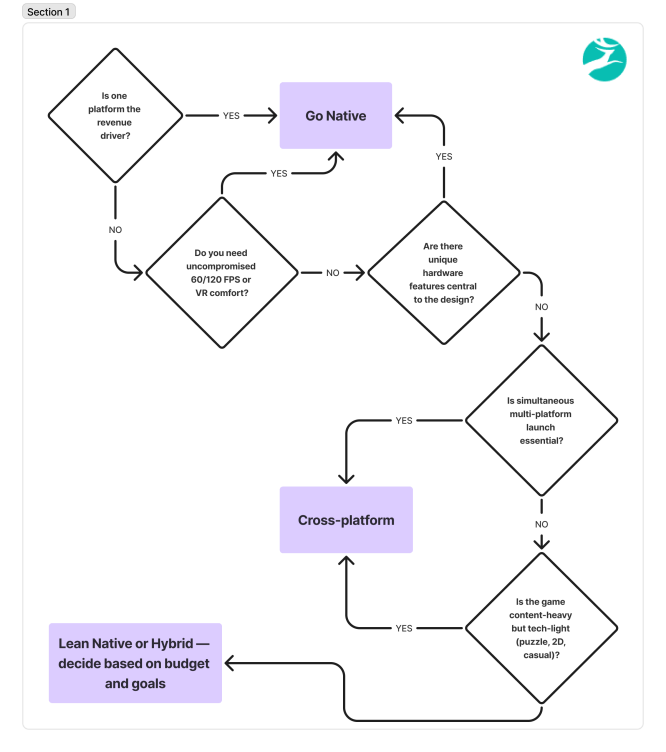
Rule of Thumb
If performance, platform identity, or certification risk are top priorities, native wins.
If reach, speed, and shared code matter most, cross-platform is the better bet.
Key takeaways for studios choosing cross-platform game design services
Hopefully, this article has clarified all the nuances of cross-platform game app development for you. This solution has its strong and weak points, which must be considered at the very beginning, when principal decisions regarding game development are being made.
Here are some takeaways that will help you make sense of all the information and serve as a guide in the world of cross-platform game development.
- Cross-platform is now the dominant approach – most studios in 2025 target multiple devices early, though native development still has its place.
- Plan for differences early – game design services must anticipate UI scaling, performance tuning, and controller support to avoid late-stage delays.
- Weigh trade-offs carefully – cross-platform saves time and budget, but can bring performance limits, generic UX risks, or longer QA cycles.
- Native remains essential for particular cases – uncompromised FPS, VR comfort, or unique hardware features still demand native builds.
- Hybrid is becoming the norm – many studios combine shared codebases with native optimizations for flagship platforms.
- Experienced partners matter – skilled cross-platform game design services ensure consistency, stability, and player satisfaction across ecosystems.
When choosing a partner for game development services, don’t just look for a game dev company that “does everything.” Focus on a team that has shipped projects similar to yours – whether that’s a cross-platform RPG, a mobile-heavy casual title, or a console-first action game. On our blog, you’ll find detailed breakdowns of real cases, tech choices, and pitfalls we’ve solved. If you’re planning your next game and want a partner who knows both the creative and technical side of cross-platform, let’s talk about your project.


